

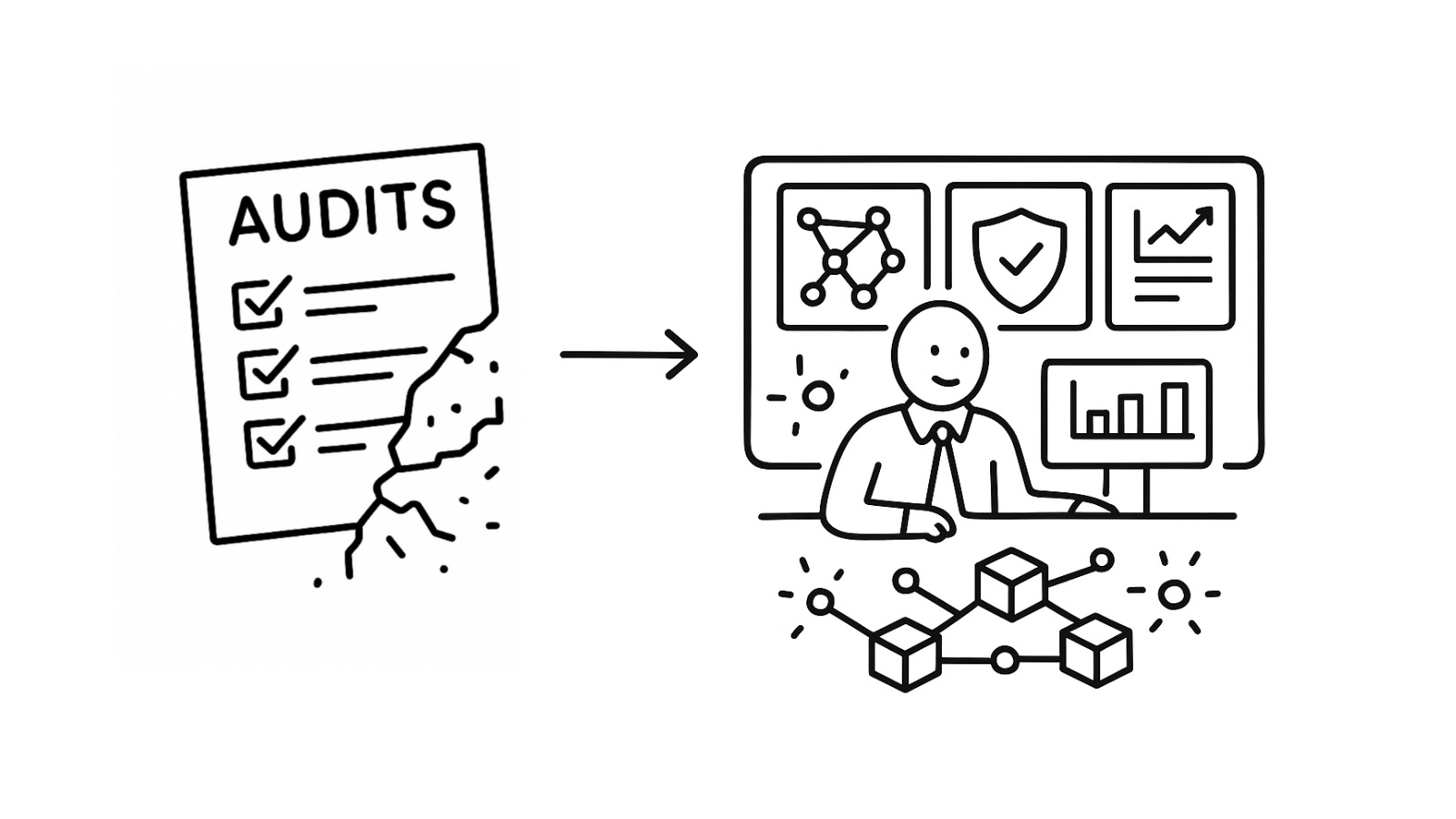
Security spending in Web3 is at an all-time high, yet losses are too. Projects lost over $2B in the first half of 2025, despite being more audited than ever. Clearly, something is missing.
It’s not that auditors are failing. It’s that audits were never meant to define safety; they validate it. Treating an audit as a guarantee is a common mistake, and one that keeps repeating.
Most exploits are not caused by exotic bugs; rather, they result from poor decisions.
Misconfigured privileges
Rushed deployments
Unreviewed internal changes
Faulty assumptions about control
Key management that fails at the worst time
Unaudited code that is pushed to production
These are not just code problems. They are leadership and operational problems.
Web3 is missing someone who actually owns security.
Shared responsibility without leadership becomes no responsibility. A Chief Information Security Officer, or CISO, fills this role in traditional Web2 organisations. A CISO is empowered to say:
“This design creates unacceptable risk.”
“This is not ready for production, including mainnet.”
“This workflow will eventually compromise keys.”
Web3 teams rarely have this role. Solidified addresses the gap by placing a virtual CISO, or vCISO, inside your team, not a consultant and not a committee. This person is responsible for day-to-day security decisions and oversight.
Why a vCISO works
A protocol’s risk is not static. Risk changes every time a contractor pushes a minor update, a new module is introduced, the team grows, integrations add new assumptions, governance powers shift, or treasury management evolves.
Attackers view the system holistically, while most teams do not. A vCISO provides full-stack visibility, helping teams move quickly without creating unforeseen attack paths.
Continuous security isn’t a marketing checkbox.
Audits fail as standalone solutions because they are periodic, while codebases and environments evolve continuously. Continuous security means regularly checking things like system design, user permissions, code quality, deployment plans, operational practices, key management, threat detection, and being ready for incidents.
No unnecessary meetings or reports. Just structure, accountability, and visibility.
Where Solidified fits
Solidified is designed for teams who do not need hand-holding, do not want fluff, and do not want another PDF.
Teams receive embedded security leadership through a vCISO, full-stack oversight, pragmatic decision-making, attack simulations, architecture design, and incentive-aligned auditing.
This is not “more services”. It is the missing layer between audits and real security.
The mindset shift Web3 needs
Security is not a checkbox, a certificate, or a PDF. It is a discipline. Teams that cultivate security through leadership, ownership, and a continuous process will define the next phase of Web3.
Get a quote for your project, schedule a call with our team, follow us on X, and sign up for our newsletter for simplified and curated Web3 security insights.